
CO2 Life Safety
CO2 Monitoring

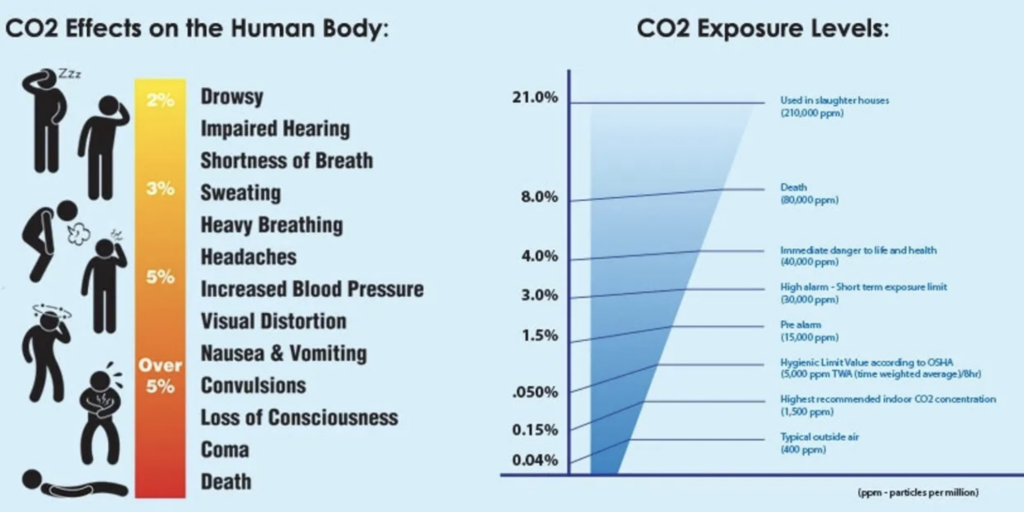
Our CO2 monitoring system is designed to protect customers and workers near stored carbon dioxide. Commonly used in food and beverage operations, carbon dioxide can create serious safety risks when released in enclosed areas. As the carbon dioxide level rises, oxygen is displaced, creating unsafe conditions that can develop without warning.
Because CO2 is colorless and odorless, changes in air quality are not always noticeable until symptoms appear. Risk is often highest in confined or poorly ventilated spaces such as walk-in coolers, syrup racks, draft systems, and areas near a CO2 supply line. In these environments, monitoring indoor air becomes critical for protecting staff and visitors.
Maintaining healthy indoor air quality requires awareness, proper equipment, and reliable alerts that activate before conditions become dangerous. CO2 monitoring plays an important role in identifying unsafe changes early and supporting safe CO2 levels in areas where compressed gas is stored or used.
Types of CO2 Safety Systems

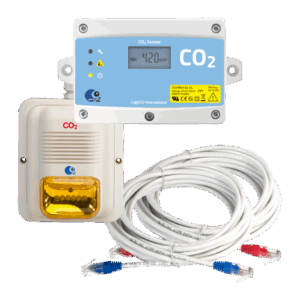
CO2 safety systems vary based on space size, layout, and operational needs. A standard setup may include a wall-mounted air quality monitor with audible and visual alerts. These devices continuously measure the CO2 concentration and notify staff when thresholds are exceeded.
Larger or more complex facilities often require multiple units working together. In these cases, sensor placement is planned around gas storage points, beverage dispensing areas, and enclosed rooms. Each sensor type is selected based on response time, accuracy, and suitability for the environment.
Some systems also integrate a dedicated CO2 detector for added redundancy, while others expand into networked configurations that support future growth.
At Broward Nelson, we design systems that scale with operations. A CO2 alarm from Broward Nelson will provide audible (loud beeping) and visible (strobe light) notifications when CO2 levels are considered unhealthy / dangerous in accordance with existing safety codes in the area being monitored.
The CO2 alarm is easy to install and use. As your CO2 storage needs increase, additional sensors and alarms can be added to the system.
Locations may include:
- Craft breweries
- Soda fountain syrup racks
- Walk in coolers
- Draft beer boxes
- Storage closets
- Pool equipment rooms
Installation and Maintenance Best Practices
Proper installation is key to reliable monitoring. Each CO2 sensor should be installed at the recommended height and placed near areas where leaks are most likely to occur. Avoid locations near doors or vents, since moving air can affect readings. During installation, each sensor should be tested so alarms and indicators work as expected.
Maintenance is just as important. Regular visual checks, basic testing, and periodic calibration help keep the system working properly. Facilities that use compressed gas systems – including carbon dioxide cylinder gases – should also review sensor placement when layouts change or new equipment is added.
A simple maintenance routine helps keep alerts dependable and allows staff to trust the system when it matters most.
Training and Response Protocols
Monitoring systems are most effective when staff know how to respond. Training should cover basic CO2 safety awareness, alarm recognition, evacuation procedures, and who to notify during an incident. Clear signage should be posted in monitored areas to reinforce response steps.
Employees should understand the difference between carbon monoxide and CO2, as both present hazards but require different responses. Drills and refresher training help maintain readiness and reduce hesitation during real events.
For added coverage, some facilities implement a secondary CO2 monitoring kit in high-risk or high-traffic zones to provide layered protection and clear visual alerts.
CO2 Telemetry Integration Highlight

Telemetry complements on-site alarms by supporting proactive oversight and faster response coordination. Systems using electrochemical sensors and digital reporting tools can also help identify gradual increases in a CO2 level before alarms activate.
When paired with monitoring solutions and beverage system support like beverage gases, telemetry contributes to safer operations and more efficient system management.
CO2 Safety Compliance for Commercial Spaces

Broward Nelson’s CO2 alarm meets all OSHA, NFPA 55, IFC and State Code requirements for CO2 alarms in restaurants, bars and more.
Compliant with US Regulatory & Safety Codes- National Board Inspection Code Part 1 Supplement 3.
- National Fire Protection Association 55 Compressed Gases and Cryogenic Fluids Code.
- Compressed Gas Association G-6.5.
- International Fire Code.
- OSHA Compliant.
Frequently Asked Questions
CO2 is a colorless odorless gas that is defined as a simple asphyxiant and is classified as a hazardous material. Co2 can be maintained in bulk tanks at pressures between 150 psig & 300 psig. Co2 in cylinders run a higher pressure, between 700 psi & 1000 psi. Additional precautions must be considered when handling CO2 and vessels under pressure
CO2 can be dangerous in enclosed spaces. With CO2 cylinders NEVER: connect a gas cylinder directly to a keg, throw or drop a gas cylinder or connect the cylinder to anything without a pressure relief mechanism on it. Remember to always ventilate the area where you are working with CO2 and always secure the cylinder during and after use.
CO2 monitors are used in restaurants, indoor greenhouses and breweries that use tanks or cylinders of compressed CO2 to warn workers of a CO2 leak.
Ask your local fire inspector to provide details about the specific code you are being asked to meet. Typically, it will be a local code, the International Fire Code, the National Fire Protection Association Code or the National Board Inspection Code.
Outside storage of tanks is allowed without a CO2 monitor but the gas being used inside requires a monitor. The points of use are typically BIB racks, beer coolers or any manifolds where beverage gas lines converge.
If you suspect a CO2 leak, leave the area immediately and alert others to do the same. Call emergency services to report the leak. Do not try to stop the leak or investigate the source of the leak yourself.
Modern CO2 sensors use non-dispersive infrared (NDIR) technology. The NDIR sensor system detects the absorption of infrared light at a wavelength equal to the size of a CO2 molecule in a sample of air. The amount of infrared light measured is proportional to the number of CO2 molecules in the air. The monitor then displays the CO2 levels in parts per million (ppm) on a screen, in an application or sends it to another device that controls an alarm system.
High levels of carbon dioxide can lead to symptoms such as headaches, fatigue, dizziness and nausea. Prolonged exposure to high levels of carbon dioxide can also lead to more serious health issues, such as respiratory problems and asphyxiation.